
Franklin Delano Roosevelt
32nd. Terms, official actions, and coverage-honest stats. Sections fill in as records land.
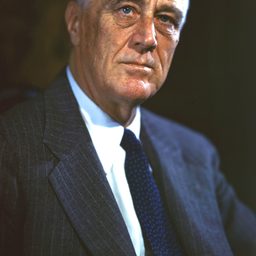
Background
- background Born January 30, 1882, in Hyde Park, New York, into prominent Delano and Roosevelt families; graduated Harvard; permanently paralyzed in 1921.
- role New York State Senator (1911–1913); Assistant Secretary of Navy under Woodrow Wilson (1913–1920); Governor of New York (1929–1932).
- achievement 32nd President (1933–1945); longest-serving and only president to serve more than two terms; defeated Hoover in 1932 landslide.
- achievement Implemented New Deal during Great Depression; created relief/recovery programs; established SEC, NLRA, FDIC, Social Security.
- achievement Re-elected in 1936 in one of largest landslide victories in American history; presided over end of Prohibition.
- controversy Unable to expand Supreme Court in 1937; conservative coalition formed to block further New Deal programs and reforms.
By the numbers
- 4,422Days in office
- 4Terms
- 3,726Executive orders
- 372 / 263Vetoes (regular / pocket)
- 9Vetoes overridden
- 222Judicial appointments
- 9Supreme Court appointments
Coverage-honest — a blank figure isn’t recorded yet.
Terms
- 32nd presidency Democratic
Job approval (Gallup)
- 19Gallup readings
| Year | Approve | Disapprove |
|---|---|---|
| 1941 | 67.7 | 24.1 |
| 1942 | 76.5 | 14.5 |
| 1943 | 71.5 | 18 |
Gallup job-approval polling compiled by the American Presidency Project — opinion data, shown with its source; not a CivicGate assessment. The chart plots the yearly average of Gallup readings over the term.
Official actions
Executive orders, proclamations, vetoes and other actions. The Community reactions are other users’ views — not a CivicGate judgment. Sign in to add yours.
No actions on file yet.
Presidents lead the executive branch. Browse other officials in People, or read how the branches fit together in the civics primer.